





































Consumer Protection
Online Choice Architecture and Vulnerability: Understanding the Impact of Reference Pricing on Consumer Behaviour
2026
PARTNERS
Citizens Advice
Share
The Behaviouralist partnered with Citizens Advice to investigate how common online sales practices influence consumer choices and wellbeing. Using a high-fidelity online simulation experiment and a randomised controlled trial, we tested whether widely used digital design tactics, such as reference pricing, sensory manipulation, and time-bound offers, lead consumers to make poorer decisions, overspend, or avoid shopping-around in online markets.
Online choice architecture in digital markets
As more economic activity moves online, the way information, products, and services are presented in digital marketplaces, known as online choice architecture (OCA), has become a growing focus for research and policy. The design of consumer interfaces isn’t neutral, and increasing evidence on OCAs demonstrates that they play an important role in shaping consumer behaviour.
Online retailers frequently use tactics such as reference pricing (e.g., “was £22.99, now £19.99”), sensory manipulation (e.g., using bold colours, or large fonts on certain deals), and time pressure (e.g., “only 20 seconds left on this offer”) to influence decisions. These practices are especially prevalent in complex markets like broadband, gym memberships, and hotel bookings, where choices are hard to compare and often involve long-term financial commitments.
While these tactics are commercially effective, there has been limited causal evidence on how they affect decision quality, competition, and consumer wellbeing, particularly for people in vulnerable circumstances.
Creating realistic simulated marketplaces to test OCAs
To address this evidence gap, we designed a high-fidelity simulation experiment where we created a realistic and interactive replica of three online marketplaces. These included broadband plans, gym memberships, and hotel bookings, that reflected how customers encountered these markets in practice. Participants completed realistic shopping tasks, selecting the best-value option that met specific needs, with the opportunity to shop-around by visiting a competing marketplace. This allowed us to measure not only decision quality and spending, but also competition-related behaviours, such as switching and searching, that are rarely captured in experimental research.
We tested three common OCA practices: reference pricing, sensory manipulation, and time-bound elements.
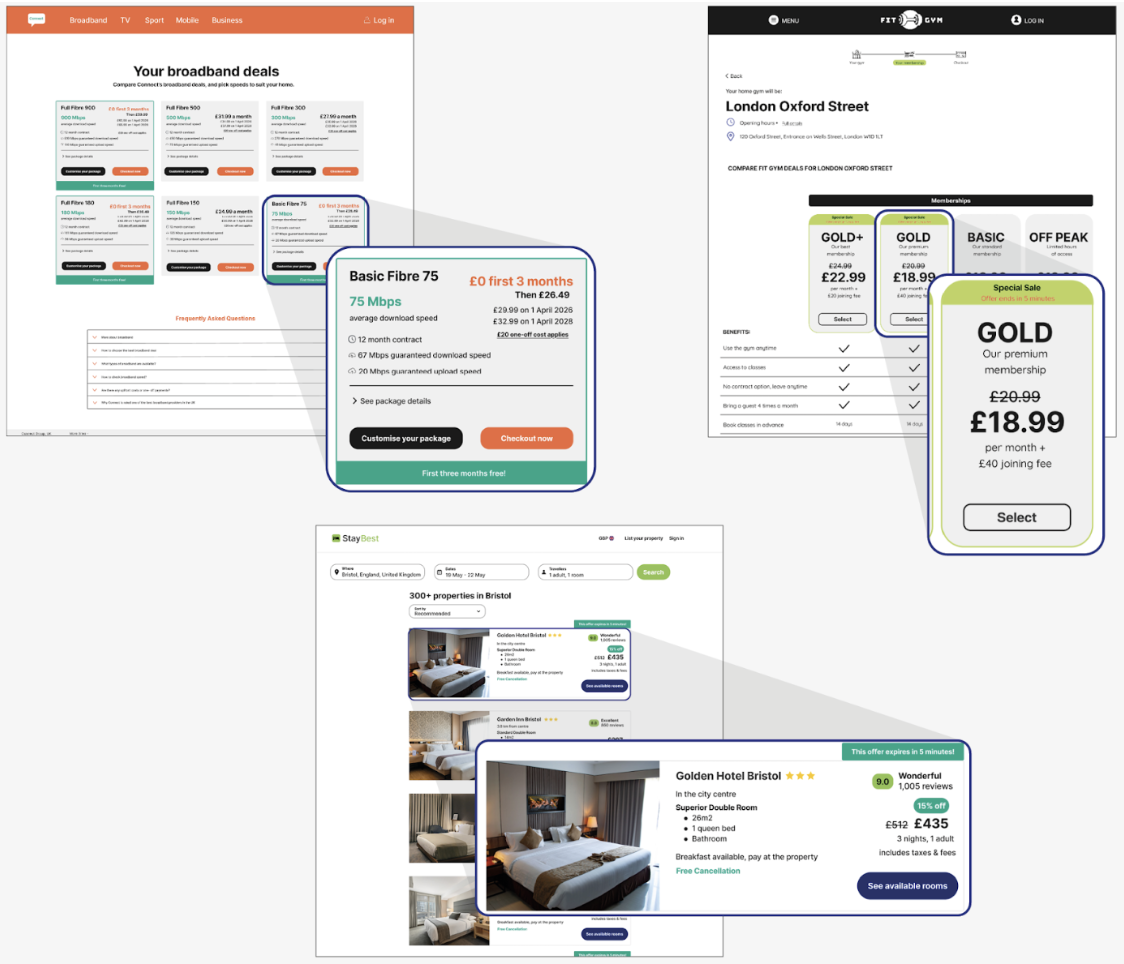
Examples of the three interactive online marketplaces we developed
Using a randomised controlled trial to measure causal impact
We conducted an online randomised controlled trial, with over 8,000 adults, nationally representative by age, gender, and region, including large subgroups experiencing financial insecurity and poor mental health.
People were randomly assigned to one of four conditions:
- reference pricing only
- reference pricing plus sensory manipulation
- reference pricing plus sensory manipulation and a time-bound element
- a control group exposed to none of these practices
All participants completed the shopping tasks, and to ensure realistic engagement, they were incentivised by entering into a lottery for each correct choice.
Reference pricing reduces decision quality and weakens competition
The results revealed several important findings across consumers and markets:
- Reference pricing reduced decision quality: Participants exposed to “was/now” prices were less likely to select the best-value option.
- Layered tactics increased harm: Adding sensory manipulation and time-bound elements generally worsened effects, though this varied across markets.
- Vulnerable consumers started at a disadvantage: People experiencing financial insecurity or poor mental health made worse choices even in clean environments, but were not disproportionately more affected by reference pricing than others.
- Broadband was challenging for everyone: Broadband decisions were difficult for all consumers, even without reference pricing.
- Weakened competition: Reference pricing reduced shopping-around, lowering visits to competitor sites.
- Confidence was misleading: Higher confidence was associated with poorer decisions, even in the absence of manipulative design.
- Skills were undermined: Self-described bargain-hunters and those with high financial literacy started out making more correct choices, but reference pricing countered this advantage.
- Spending increased: Reference pricing, especially when combined with other tactics, led consumers to spend more overall.
Implications for consumer protection and digital market design
This study provides ecologically valid and policy-relevant evidence on how OCAs shape consumer behaviour in realistic digital environments. It shows that common sales tactics can harm consumers, weaken competition, and undermine informed decision making. These findings underscore the importance of careful design and regulation of digital marketplaces.
You can read the full report here.