



















Consumer Insights
Redesigning Loyalty Around Consumer Habits
2026
PARTNERS
Consumer Packaged Goods (CPG) brand
Share
The Behaviouralist partnered with a leading consumer packaged goods (CPG) brand to investigate why customers were not buying consistently from the brand despite its strong market presence. After conducting a behavioural diagnosis, we designed and tested loyalty interventions that measurably increased retention, spend, and share of wallet.
Understanding loyalty in everyday consumer decisions
A category-leading consumer brand had strong reach and was present in most households, yet customers were not consistently returning to the brand or prioritising it in their purchases. Annual spend per customer was low and many consumers routinely split purchases across competing brands. While a loyalty app, traditional marketing and promotional strategies were already in place, these approaches were not improving loyalty. The challenge was not awareness or product quality, but understanding why customers were not forming lasting routines with the brand.
Loyalty is often assumed to follow naturally from good products or strong branding. In reality, purchasing decisions are shaped by habits, convenience, and small nudges. Once routines form, consumers tend to repeat them unless something disrupts those patterns. Strengthening loyalty therefore requires understanding how habits develop and designing interventions that reinforce them. This is also what makes loyalty difficult to study, as it unfolds over time through repeated decisions, rather than as a single behavioural outcome.
Using behavioural science to diagnose loyalty barriers and design habit-forming interventions
We used behavioural science to understand how purchasing habits form, and how loyalty can be strengthened within these everyday purchasing decisions. We approached this in three stages.
First, we audited the existing loyalty app and marketing efforts to identify friction points and missed opportunities. Second, we conducted a mixed-methods behavioural diagnostic to understand what drives switching and what sustains loyalty across different customer segments, such as users and non-users of the existing loyalty app. Third, we designed and tested behaviourally informed and scalable interventions that aimed to make loyalty easier and more rewarding, not just in a transactional way, but by aligning incentives with customers’ natural purchasing habits.
Combining diagnostics with large-scale experimentation to test loyalty solutions
Phase 1: Scoping
We began by conducting stakeholder interviews to align on business priorities and key commercial objectives, followed by a comprehensive behavioural audit of the loyalty app, CRM campaigns, and user journeys. We benchmarked the programme against leading loyalty programmes across industries to understand how the brand compared to best practice in loyalty design. As part of this process, we mapped the target behaviours the programme aimed to drive and identified potential friction points along the customer journey. Through this work, we identified more than 45 opportunities to improve the customer experience using behavioural science.
Phase 2: Behavioural diagnostic
We ran two large-scale quantitative surveys with almost 3,000 participants–one with loyalty app members and one with non-members–to identify the behavioural drivers of loyalty. We also conducted focus groups with participatory exercises to give us a richer picture of the journey from first purchase to repeat purchasing.
This process revealed three behavioural customer personas. The personas don’t differ in what they buy, but in how they decide, how frequently they shop outside the brand, and whether switching is triggered by internal motivations (e.g. a desire to explore) or external factors (e.g. competitor price promotions). This provides a complementary lens to the brand’s existing segmentation by explaining not what customers buy or look for, but how they make decisions: the routines, preferences, and mental shortcuts that either drive loyalty or erode it.
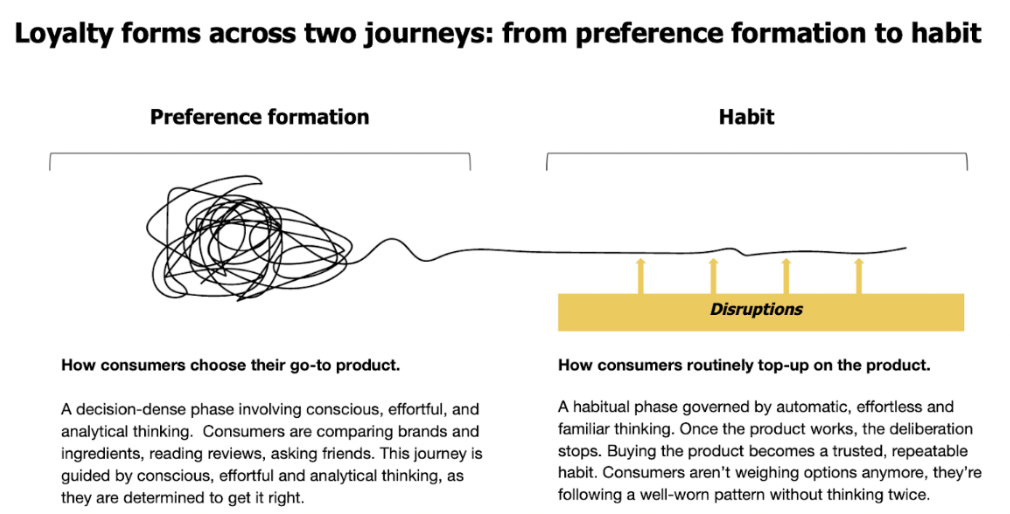
Diagram showing how consumer loyalty is formed
Phase 3: Behavioural experiments
Working with the client across co-design workshops, we developed two targeted interventions. The first used a tiered rewards structure, drawing on the goal gradient effect, reciprocity, exclusivity, and gamification to make loyalty feel like a natural progression rather than a transaction. The second addressed variety-seeking behaviour directly, using personalisation and proactive product suggestions to redirect curiosity toward the brand's own portfolio rather than competitors.
We tested both in a realistic simulated shopping environment, where nearly 9,000 participants made purchasing decisions across multiple rounds. We randomly introduced potential disruptions, such as products being out of stock or competitor price promotions, to see whether the interventions could protect loyalty when it was under pressure. This methodology allowed us to measure real decision-making behaviour rather than simply stated intentions.
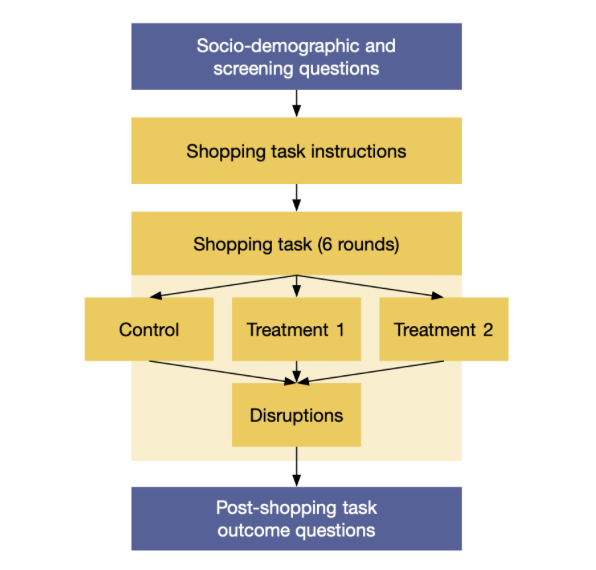
Flowchart of Phase 3: Behavioural experiments
Customers are loyal to habits, not brands
The main finding is that customers are loyal to habits, not brands. This means that loyalty programmes work best when they fit naturally into existing routines rather than trying to change them.
Both interventions produced strong results. The first increased brand purchases by 29% and share of brand purchases by 17%. The second intervention increased purchases by 16% and share of purchases by 13%. Effects held consistently across all consumer types.
The interventions also made loyalty resilient. When faced with disruptions, such as competitor price promotions or products being out of stock, participants in the intervention groups were more likely to switch within the brand’s portfolio rather than to competitors. Beyond purchasing behaviour, both interventions improved brand perceptions and future purchase intentions, with participants providing positive feedback to both solutions.
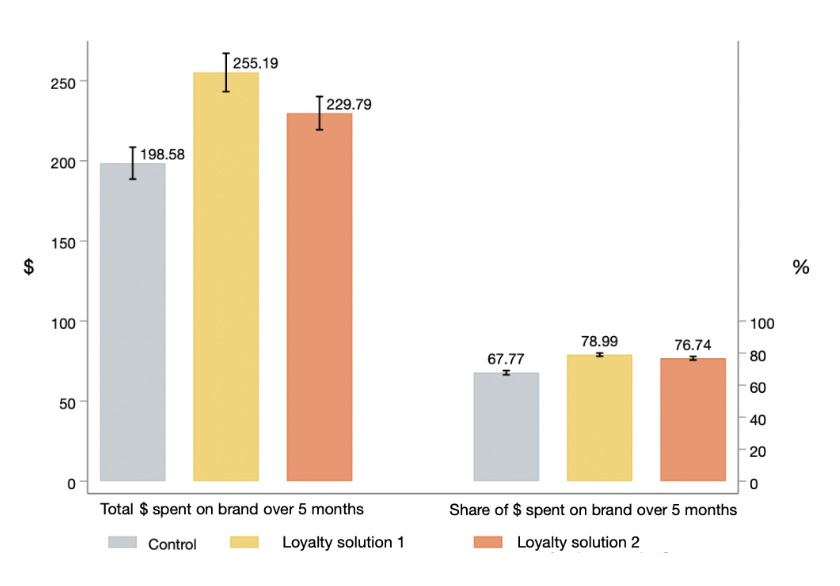
Table showing results of the two loyalty interventions on total $ spend and share of $ spend over 5 months
Designing loyalty programmes that reinforce customer habits rather than trying to change them
This study demonstrates that loyalty programmes can be designed around consumer habits rather than traditional rewards, consequently delivering measurable commercial impact while respecting existing routines. We identified actionable insights and tested scalable interventions that increased spend, share of wallet, and emotional connection to the brand.
The project also revealed that loyalty solutions can be tailored to different consumer segments, protecting customers from switching under disruptions and reinforcing repeat purchasing over time. This work provides a roadmap for long-term loyalty strategy that is both practical and behaviourally informed.
Is your loyalty programme not working as well as it could or are you thinking of creating a new programme? We help brands identify what might be limiting loyalty and design solutions that increase repeat purchases, consumer engagement and experience. Get in touch at hello@thebehaviouralist.com or on LinkedIn if you would like to know more!