

































Energy
Encouraging Demand Flexibility in Ireland: Using Behavioural Insights to Accelerate the Energy Transition
2026
PARTNERS
Sustainable Energy Authority of Ireland (SEAI)
Share
The Behaviouralist was commissioned by the Sustainable Energy Authority of Ireland (SEAI) to develop taxonomies and roadmaps to support Ireland’s demand flexibility and decarbonisation goals. The project provides a systems-level framework to guide national energy transition policies. The taxonomies help prioritise key challenges and opportunities, while the roadmaps outline when and where interventions can have the greatest impact, offering practical, evidence-based guidance for policymakers, Distribution System Operators (DSOs), regulators, and utilities.
Why electricity demand flexibility matters for Ireland’s climate goals
Ireland's Climate Action Plan 2023 commits to halving greenhouse gas emissions by 2030, which requires major shifts in electricity use. However, energy demand is rising due to electrification, Large Energy Users like data centres, and household adoption of EVs and heat pumps. In Ireland, households alone account for 50% of peak electricity demand (Eirgrid, 2022).
Energy demand flexibility, which is the ability of energy users to adjust their energy usage in response to supply signals, can help ease grid pressure, yet participation remains low. Despite the installation of nearly 2 million smart meters across Ireland, engagement has been limited due to challenges such as inertia, perceived complexity, and limited awareness. Behavioural science, applied through a systems thinking lens, can help develop strategies to encourage flexible energy use, smart technology adoption, and participation in demand-side schemes.
Three behavioural taxonomies
To design effective demand flexibility interventions, it is essential to first understand and categorise the behaviours that influence energy use. Developing behavioural taxonomies allows policymakers to identify where interventions are most feasible, impactful, and suited to different households and technologies. Our work is the first comprehensive behavioural taxonomy developed specifically for demand flexibility in Ireland, providing a structured foundation for evidence-based policy design.
Drawing on a literature review, we identified practically relevant criteria, such as behavioural frequency (one-off or habitual), behavioural agent (user-led or appliance-led), cognitive and physical effort, financial cost, and energetic impact, to guide intervention design. Using these criteria, we developed three taxonomies that classify behaviours:
- Behaviour Changes categorised actions from habitual (e.g., cold water washes, closing unused room doors) to automated (e.g., programming dishwashers for off-peak hours).
- Programmes and Services examined engagement with Time-of-Use (ToU) tariffs, dynamic pricing, Direct Load Control, and voluntary reduction events. Signing up for these services is easy, but optimising usage under dynamic tariffs demands high effort due to unpredictable pricing and attention to consumption timing. Direct Load Control offers low-effort flexibility once trust and perceived loss of control barriers are overcome.
- Technologies assessed smart appliances, heat pumps, EVs, and solar PV systems. Adoption requires investment and set-up effort, but once automated, flexible operation (e.g., EV charging during off-peak times) becomes low-effort and high-impact.
Identifying priority behaviours by segment
We identified two distinct types of household with different levels of technology ownership. As a result, the optimal behaviour changes for these households differ.
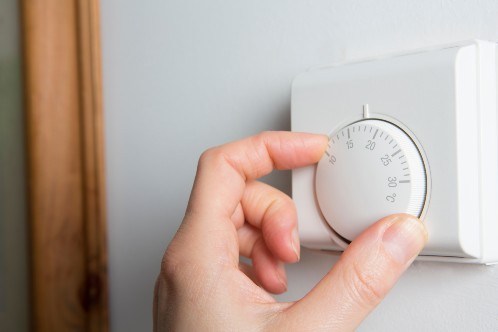
- Low-tech households: Accessible, low-cost habitual changes (short showers, minimising ovens, closing doors, adjusting thermostats manually) require regular engagement but minimal investment.
- High-load technology households: One-off automated actions (scheduling smart appliances for off-peak, integrating EV chargers with time-based tariffs, configuring heat pumps flexibly) deliver major grid benefits with minimal ongoing effort.
Seven demand-flexibility roadmaps
To complement the taxonomies, we developed seven roadmaps that apply a temporal, systems thinking lens to explore how households progress through different stages of adoption and sustained use. Each roadmap traces a behavioural journey across four key stages - Trigger, Consideration and Planning, Action, and Sustained Flexible Behaviour. These stages are adapted from the Transtheoretical Model of Behaviour Change and informed by the Theory of Planned Behaviour.
At each stage, they map behaviours, barriers, and policy or behavioural interventions to enable action. This methodology allows policymakers, regulators, and utilities to pinpoint where interventions will have the greatest impact and to design more targeted, scalable programmes. For instance, the Peak Shaving and Shifting roadmap shows how combining automation and real-time feedback can sustain long-term behavioural change.
The seven roadmaps cover:
- Peak Shaving and Shifting
- Electricity Tariff Switching
- Demand Response Programmes
- Smart Appliance Adoption
- Heat Pump Adoption
- Electric Vehicle Adoption
- Solar PV Adoption
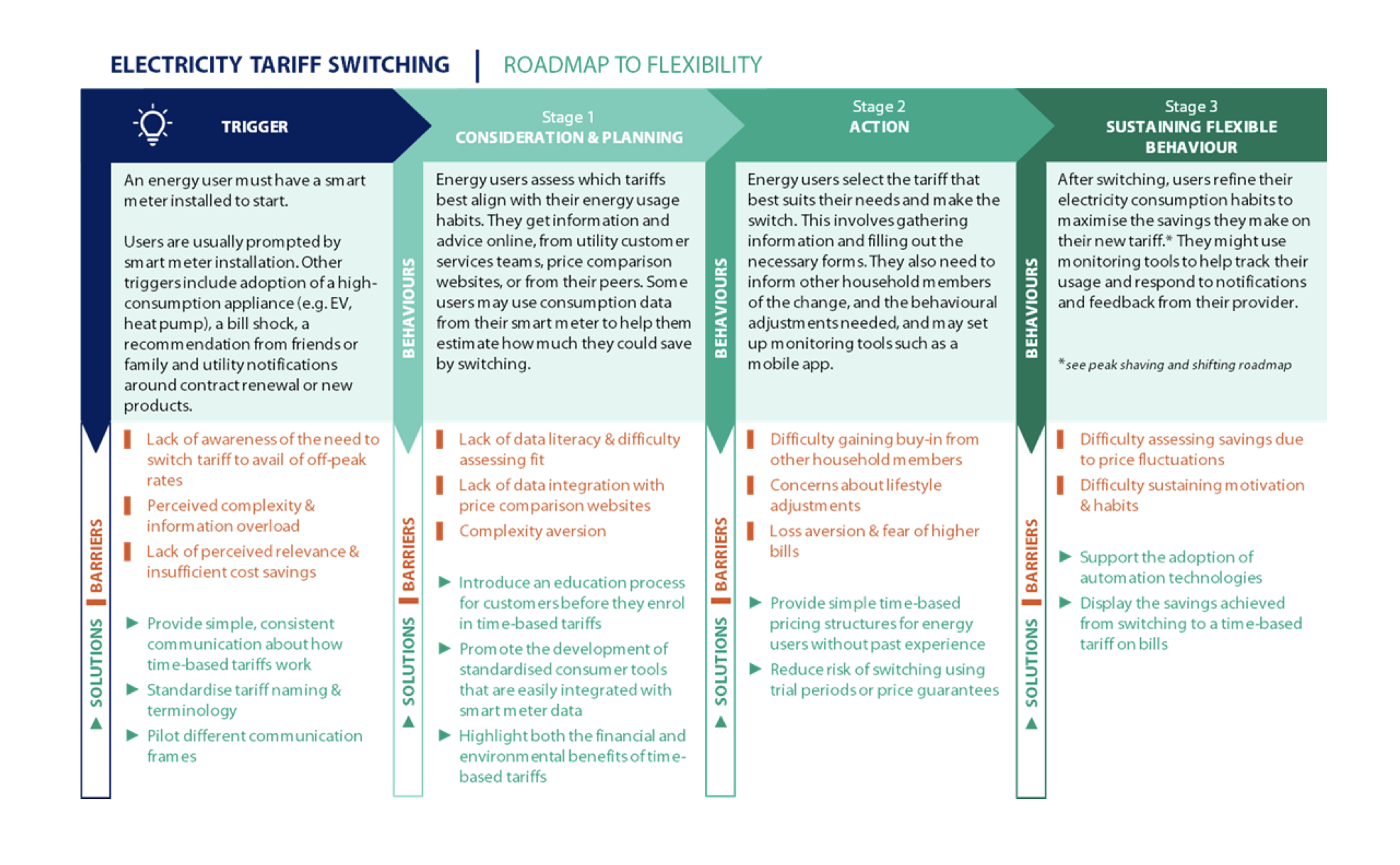
The Electricity Tariff Switching Roadmap
Delivering systematic frameworks for scalable policy
Together, these taxonomies and roadmaps provide policymakers, DSOs, regulators, and utilities with systems thinking tools for designing targeted intervention design across user types and stages. By connecting behavioural insights to technical and policy levers, this approach directly supports Ireland’s goal of achieving 20-30% demand flexibility by 2030, shifting consumers from passive users to active participants in a low-carbon energy system. Early initiatives such as SEAI and ESB’s Beat the Peak pilot demonstrate how behavioural insights can translate into real-world impact.
At The Behaviouralist, we apply systems thinking methodologies, including stakeholder analyses, behavioural journey mapping, and theory of change analyses, to design interventions that address the right challenges at the right level. This ensures that policies are scalable, impactful, and evidence-based to accelerate their transition towards sustainable energy systems.
You can read the full SEAI report here.