






































Consumer Protection
Behavioural Audit of Dark Patterns, Addictive Design and Misleading Influencer Marketing
2026
PARTNERS
Finance Watch
Share
The Behaviouralist was commissioned by Finance Watch to investigate how manipulative design features on the websites and apps of financial institutions and financial influencers (“finfluencers”) shape the decisions of retail investors. Using a behavioural audit of banking and trading-app and website interfaces alongside a systematic analysis of finfluencer content, we examined whether manipulative design practices and persuasive communication techniques can push consumers to take on risk they do not fully understand, or to act on incomplete information.
Dark patterns in banking and trading interfaces
Behavioural science research demonstrates that decision-making under uncertainty – including about investments – frequently relies on heuristic processing, the simplified mental shortcuts that reduce cognitive effort by enabling us to make quick judgements without fully evaluating all available information. While these shortcuts are useful and often necessary, they also increase our susceptibility to manipulative design choices, and the way choices are presented.
Financial institutions and finfluencers can take advantage of this. The websites and apps of firms can shape user behaviour by influencing how information is presented, which actions are prioritised, and how friction is introduced or removed from specific decision pathways, deciding what is prominent, what is buried behind a drop-down, what is set as the default, and what is made to feel urgent.
This matters, because investing itself has also changed drastically. What was once mediated by professional advisors now increasingly happens directly on our smartphones; anyone can open a brokerage account in minutes and begin trading. Banks, neobanks, and trading platforms compete for the same attention as social and e-commerce platforms, and increasingly draw on the same toolkit to do it.
At the same time, social media has become an increasingly important source for financial information. Finfluencers disseminate investment advice, promotions, and trading strategies across platforms such as YouTube, Instagram, and TikTok, and have become a genuine source of investment guidance, particularly for many first-time investors. Their content often blends entertainment, lifestyle branding, and financial messaging, blurring the distinction between impartial information, advertising, and speculative promotion with financial literacy content or product recommendations.
This growing use of manipulative or addictive digital design has also attracted regulatory scrutiny within the EU. Some forms of deceptive interface design – commonly known as "dark patterns” – are restricted under EU consumer-protection and digital-services legislation, including provisions on unfair commercial practices, transparency obligations, and platform accountability. These developments reflect growing concern
about the potential for digital environments to exploit behavioural vulnerabilities, impair autonomous decision-making, and encourage harmful financial behaviour. However, regulatory gaps remain as existing legislation is limited in its scope and is, in some cases, legally unclear.
Methodology: A Two-Strand Investigation
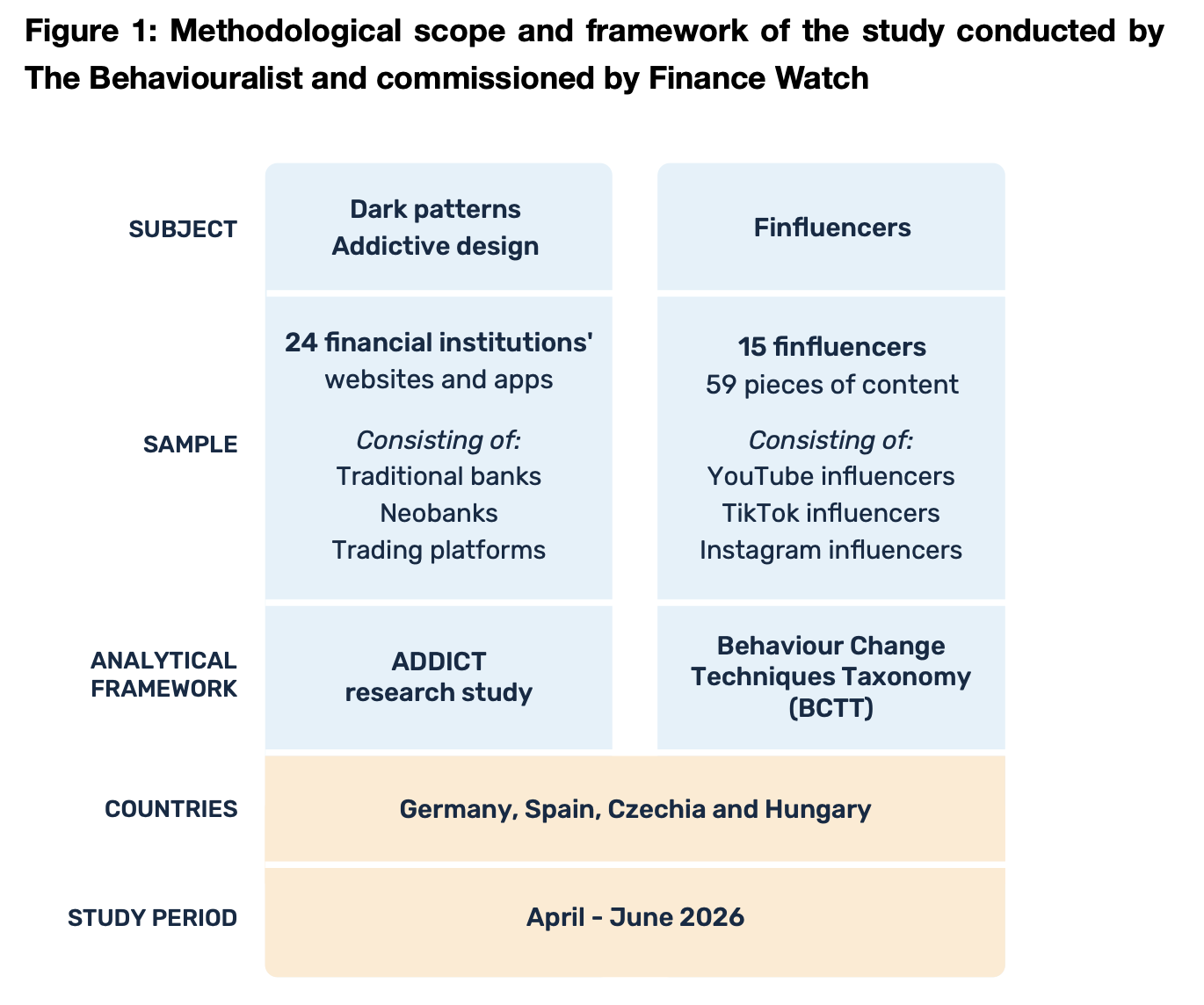
Our team conducted a behavioural audit of 24 financial institutions across Germany, Spain, Czechia and Hungary, covering a mix of traditional banks, neobanks and trading platforms. Using the ADDICT taxonomy of manipulative digital design, we systematically catalogued design features across each platform's user journey and rated the consumer-protection risk associated with each. While ADDICT was originally developed to analyse manipulative design on social media platforms, we adapted it for financial interfaces, which increasingly deploy comparable engagement-driving mechanics to those found on social platforms.
In parallel, we also analysed 59 pieces of content from 15 leading finfluencers across YouTube, Instagram, and TikTok in the same four countries. Content was coded for communication style, product risk disclosure, commercial ties with product providers, and persuasion technique using the Behaviour Change Technique Taxonomy, the widely used behavioural-science framework that classifies 93 distinct techniques for influencing attitudes and behaviour.
Key Findings: Dark Patterns and Finfluencer Risks
- Manipulative design is widespread: over 150 potentially manipulative design practices were identified across the webistes and apps audited, most of which were rated medium or high risk. Trading platforms and neobanks showed a notably higher concentration of practices than traditional banks, though differences between mobile-app and website interfaces could not be fully disentangled from institution type.
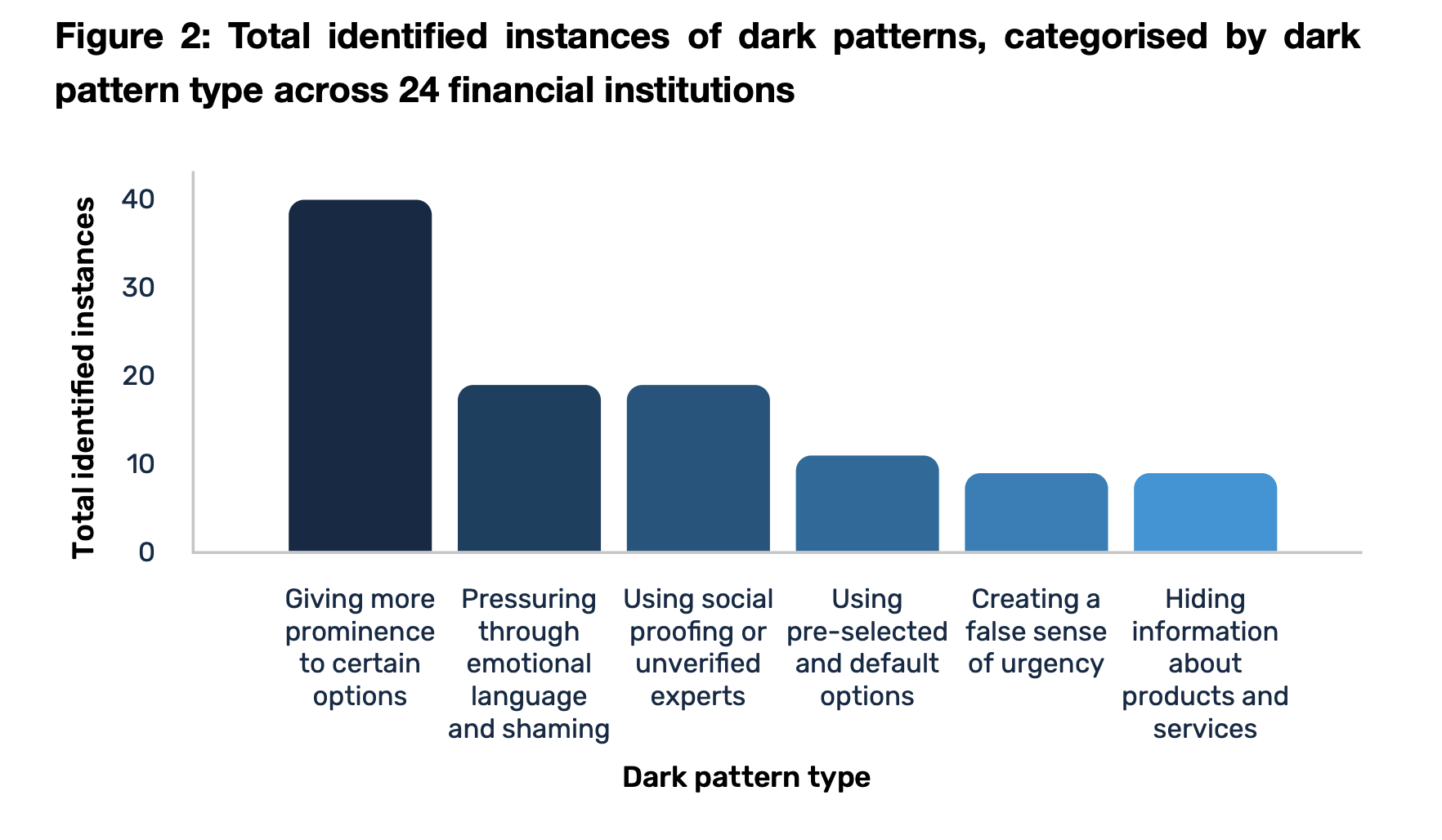
- Features giving more prominence to certain options were the highest practice: This practice took three forms: continuously refreshed live price and performance updates using red/green colour coding; "trending" or "most popular" asset lists that leverage social proof to direct attention toward specific products; and embedded live market news feeds tied to real-time price movement. What made these features particularly important was that they were built into the core experience. Users could not simply switch them off, even if they preferred not to be exposed to constant market updates.
- Financial institutions also used more targeted ways of steering decisions: Institutions also used a range of additional dark patterns. Pressuring through emotional language or shaming by using, for example, loss-aversion framing was used extensively at onboarding. For example, one bank's flow warned users that "money can lose value" and paired this with an interactive calculator projecting the purchasing power they stood to lose by not investing, without equivalent visibility for the risk of losses from investing itself. In addition, social proofing and misleading “expert” recommendations were commonly used. For example, algorithmic "buy" recommendations were presented with strong authority signalling (e.g. “91% of analysts recommended buying”), without surfacing the uncertainty or dissent behind that figure. Default settings and pre-populated deposit amounts also quietly steered users toward specific outcomes, users may not have chosen otherwise.
- Finfluencers generally promoted long-term investing: We found that ETF investing, diversification, and long-term strategies dominated finfluencer content across all four countries, frequently framed as accessible to non-wealthy, first-time audiences ("you don't have to look at charts"). Content style varied by both platform and market:YouTube favoured a more structured, educational-analytical register, while short-form videos often used role-play and dialogue. We also noted some national differences; German creators emphasised financial literacy and diversification, Spanish creators leaned toward aspirational, life-coaching- style messaging, and Hungarian creators frequently discussed country-specific tax-advantaged investment products.
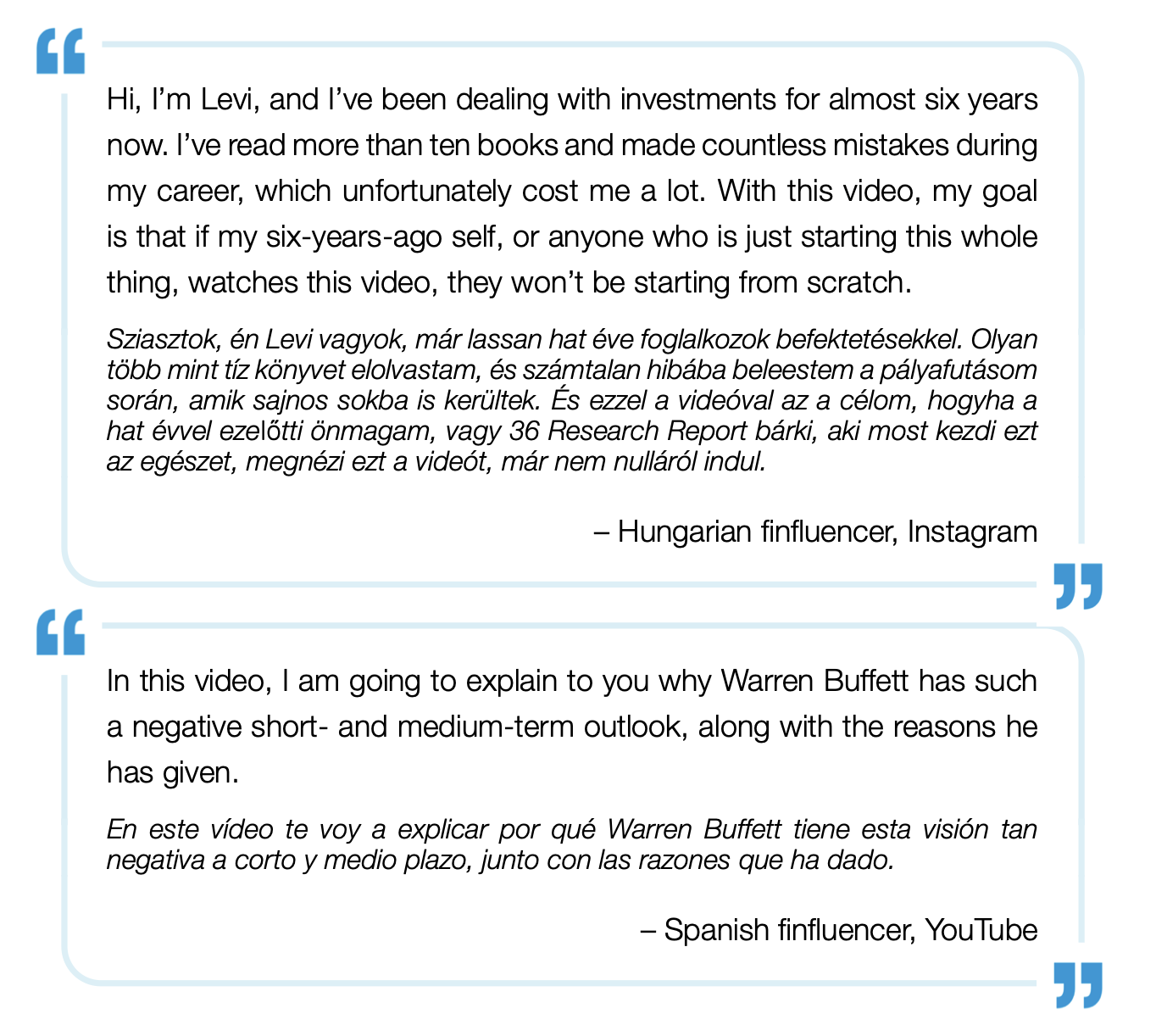
- Persuasion often relied on perceived credibility: The most common persuasion technique was credible-source signalling, appearing in roughly half of the content we analysed, without credibility ever being established through formal qualifications. Finfluencers often built authority through their personal track record, references to well-known figures such as Warren Buffett, or by positioning themselves as more trustworthy or relatable than traditional banks.
- Limited product risk communication: The biggest gap we found was between how strongly finfluencers persuaded audiences and how clearly they communicated product risks. Nearly three in five videos offered only a generic, disconnected "not financial advice" disclaimer; on TikTok, this rose to almost every video analysed, while YouTube accounted for nearly all instances of substantive, detailed risk discussion.
- Commercial interest is common: 71% of the finfluencer content we analysed involved a commercial interest, such as sponsorships, affiliate links and the promotion of paid products such as courses, communities and memberships. In many cases, the commercial element was woven directly into content that was otherwise presented as educational. This can make it difficult for viewers to distinguish between genuine financial guidance and content that is also designed to generate revenue.
What does this mean?
Our findings suggest that online interface design and finfluencer persuasion are not two separate risks, but can compound one another. Each channel can reinforce the gaps left by the other. A user who has just watched a finfluencer frame inaction as a loss, delivered in a confident and credible-sounding way, may then open an app whose interface reinforces the same message through trending lists, real-time gains or a “recommended” auto-invest option just one tap away. Equally, changing interface design will only go so far if social media continues to expose users to highly persuasive, commercially motivated financial content with limited risk information.
Our research provides real-world evidence of how these two environments can shape investor behaviour across European markets. It has clear implications for the implementation and further development of EU digital-finance and consumer-protection rules, as well as wider discussions around retail investor protection and platform disclosure. More broadly, it reflects a challenge we are increasingly seeing across emerging technologies: how technology can be used to influence people at moments when they are making important decisions,often without them fully realising how they are being influenced. As retail finance becomes more digitalised, personalised and increasingly intertwined with social media, protecting consumers will require regulators to look across these different areas rather than treating them in isolation.
Click here to read the full report published by Finance Watch.