

January 2026
Kira Hinsley
Share
Applying Behavioural Insights to Encourage Sustainable Home Renovations
Building Renovation Passports (BRPs) are central to the EU’s strategy to decarbonise buildings. They are designed as dynamic documents that record past works, plan future renovations, and provide valuable data for owners, valuers, and lenders. However, their success depends on whether homeowners actually use them. This blog explores how behavioural science can help transform BRPs from static records into practical changemakers, overcoming barriers such as choice overload, low confidence, and financial concerns.
The EU needs to close the “renovation gap” to reach climate targets
Buildings account for 40% of the EU’s energy use and 36% of CO₂ emissions. The sector must cut emissions by 60% by 2030 and achieve full decarbonisation by 2050 to meet EU-set targets. Improving the depth and rate of renovation is therefore essential and has been central to the revision of the Energy Performance of Buildings Directive (EPBD).
With this in mind, the EU is rolling out Building Renovation Passports (BRPs) that provide personalised renovation roadmaps to homeowners. Unlike one-off renovation plans, a BRP provides a 15–20 year staged approach that maximises energy efficiency and avoids “lock-in” effects (when early upgrades make future, deeper renovations harder or more expensive). Under the revised EPBD, Member States must establish national passport schemes by May 29, 2026. By linking BRPs with Energy Performance Certificates (EPCs), the EU intends to give homeowners, investors, and prospective buyers a comprehensive view of a building’s current performance and planned interventions. This should help simplify planning and reduce risks associated with renovation investment. However, use of BRPs is optional, meaning that achieving uptake from homeowners will be critical to their success.
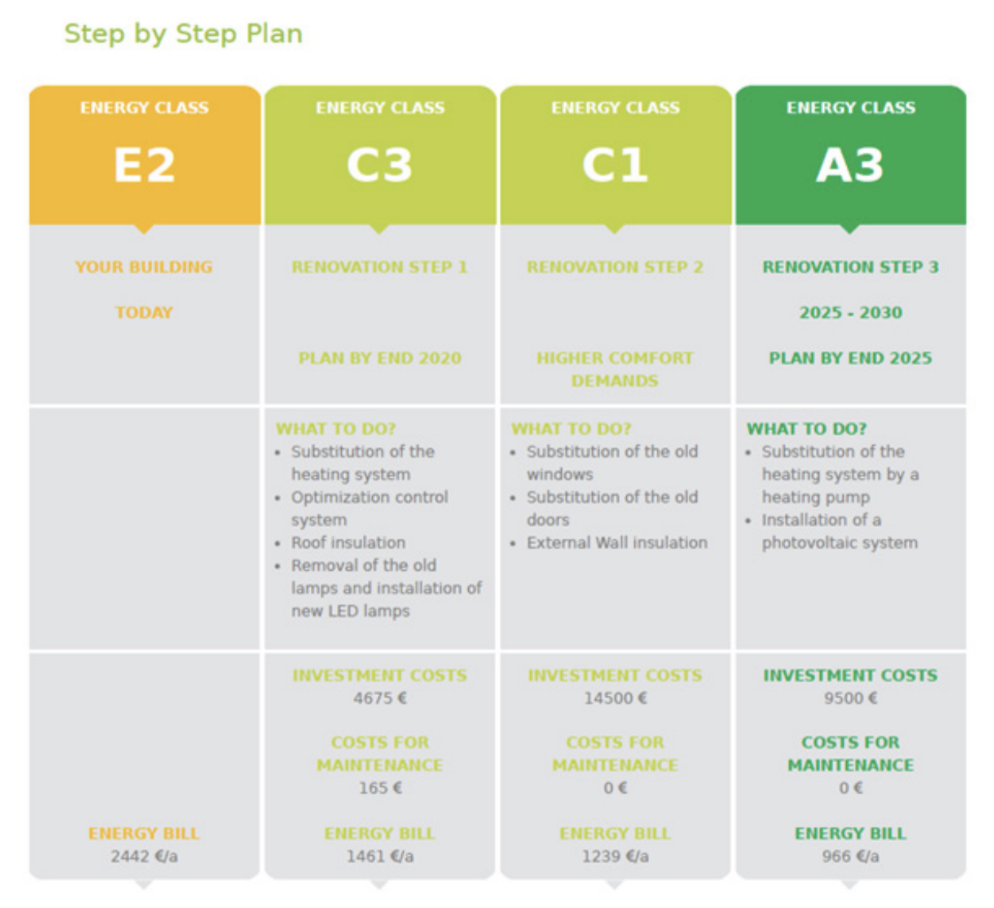
Example of a potential BRP proposed in Ireland
Applying behavioural insights to enhance Building Renovation Passports
BRPs already incorporate several features that address behavioural barriers, such as:
- Clear hierarchies of measures, so homeowners can see which upgrades matter most and in what sequence.
- Simplification of complexity through step-by-step long-term roadmaps.
- Connectivity by linking owners with vetted contractors, financiers, and service providers.
- Personalisation by using property-specific data instead of generic advice.
However, the EU directive leaves room for member states to design them as they wish. Applying behavioural insights can ensure they are as user-friendly as possible, and enhance their adoption. One useful approach is the EAST framework, which provides four guiding principles: Make the target behaviour Easy, Attractive, Social, and Timely.
Make it Easy
Choice overload is a major barrier to renovation. Homeowners may feel overwhelmed when faced with multiple options for heating, insulation, windows, and ventilation. BRPs can make decisions easier by:
- Using smart defaults: Highlighting the most impactful upgrades first.
- Reducing hassle: Streamlining access to contractors and financing options through one-click links.
- Simplifying messages: Breaking down complex technical language into clear and plain steps.
- Facilitating implementation intentions: Prompting homeowners to map out when and how they will act can make the behaviour easier to follow through.
Make it Attractive
People are more likely to act when interventions are appealing and engaging. BRPs can increase attractiveness by:
- Visual cues and rewards: Using images, infographics, and simple metrics to show potential energy savings and comfort gains.
- Framing financial benefits: Presenting costs as manageable monthly payments and highlighting net savings after grants, tax incentives, or energy reductions. This is crucial as financial concerns are a key barrier to renovations.
- Reducing perceived risks: Offering transparent information on warranties, quality assurance, and dispute resolution to reassure homeowners.
Make it Social
Social influence strongly shapes behaviour. BRPs can use this by:
- Using social proof: Showcasing case studies from similar properties in the area, showing costs, upgrades, and energy savings achieved.
Make it Timely
Timing interventions can significantly increase follow-through. BRPs can act on this principle by:
- Highlighting immediate benefits: Emphasising immediate comfort and health benefits, not just long-term pay-offs.
- Reinforcing implementation intentions: Sending reminders that align with users’ pre-defined renovation plan, nudging them from intention to action.
Making BRPs work in practice
BRPs are a promising tool for accelerating renovation and helping the EU meet its climate targets. However, they will only be effective if homeowners adopt them. Behavioural science can ensure that renovation passports are not just technical plans but practical, user-centred tools that help people navigate renovation decisions and proceed with confidence. While behavioural insights are a powerful enabler, structural and financial challenges, such as access to affordable financing, skilled contractors, and regulatory support, must also be addressed. By combining behavioural insights with broader policy and financial instruments, BRPs can become a central part of the EU’s path to full decarbonisation.
If you are interested in applying behavioural science at your organisation, please don't hesitate to reach out; we'd love to brainstorm ideas with you and potential opportunities to work together!